Reference: Journal of Applied Physics 49
(1978) 5823-5826
Authors: Finger, L W, Hazen, R M
Layman's explanation:
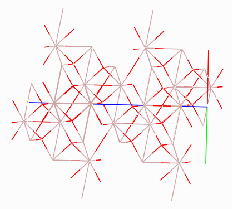
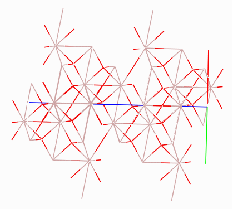
Corundum or ruby is one of the oldest gems known to man. There is evidence of a Greek scholar, Theophastus, classifying precious stones such as rubies as early as 350 B.C. The first time Rubies were introduced in Europe was during the Greco-Roman times. Some of the best known producers of Corundum around the world are Southeast Asia, Australia, and southern Africa. In the U.S., it is found in North Carolina and Montana. Corundum is basically used as a gemstone for jewelry, but because of the high price scientists have made an inexpensive synthetic ruby. It is also used as an abrasive because of its hardness; it is employed industrially as a component of large machines to sandpaper.
Lab name:
Common molecules
Sample provider:
Obtained from the Inorganic Crystal Structure Database
Reciprocal Net site software 0.9.1-50,
copyright (c) 2002-2009, The Trustees of Indiana University
Files and data presented via this software are property of their
respective owners.
Reciprocal Net is funded by the U.S. National Science Foundation as part of
the National Science Digital Library project.