Reciprocal Net Site sponsor
   Site Info    |    Search
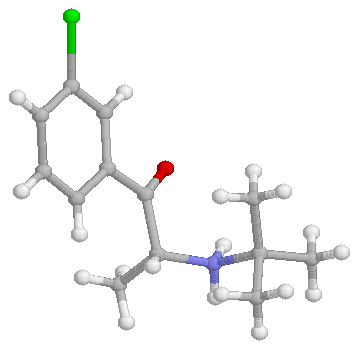
Common molecules sample 50715 - Reciprocal Net Log in
You will need to download and install a Java plug-in in order to view this applet. Download Sun's Java plug-in from here.

Switch to another visualization applet:

> miniJaMM open in new window...
- JaMM1
- JaMM2
Empirical formula: C13H19Cl1N1O11
a: 7.571 Å
b: 9.310 Å
c: 11.687 Å
α (alpha): 94.58 °
β (beta): 101.49 °
γ (gamma): 90.15 °
Volume: 804.54 Å3
Space group: P-1
Calculated density: 1.654 g/cm3
Z: 2
Temperature: 22.0 °C
Formula weight: 400.747 g/mole
R(F): 0.0560
Trade name: Wellbutrin
Common name: Bupropion
CSD refcode: NUFSOW
Short description: Bupropion is an anti-depressant of the amino-ketone class.
Keyword: smoking cessation
Keyword: antidepressant
Citation of a publication: Reference: J.Chem.Inf.Comput.Sci., #38(1998)p506 Authors: M.Froimowitz, C.George
IUPAC name: N-t-Butyl-1-(3-chlorobenzoyl)ethylammonium salt
Layman's explanation: N.B. Mehta and D.A. Yeowell of the Wellcome Foundation, Ltd. first patented bupropion HCl as an antidepressant in 1971. Since then, the drug has been marketed under the names Wellbutrin and Zyban. Bupropion works by an unknown mechanism, but is involved in the dopaminergic and noradrenergic systems. It is a weak inhibitor of neuronal uptake of norepinephrine, serotonin, and dopamine. Bupropion is marketed as Wellbutrin for the treatment of depression and attention deficit disorder and as Zyban (in stustained release form) for help in smoking cessation.
Lab name: Common molecules
Sample provider: Obtained courtesy of the Cambridge Structural Database
Status: Complete, visible to public
Repository Files:
50715.cif 50715.crt 50715.GIF 50715.ort 50715.pdb
50715.sdt

Reciprocal Net site software 0.9.1-50, copyright (c) 2002-2009, The Trustees of Indiana University
Files and data presented via this software are property of their respective owners.
Reciprocal Net is funded by the U.S. National Science Foundation as part of the National Science Digital Library project. NSDL