Reciprocal Net Site sponsor
   Site Info    |    Search
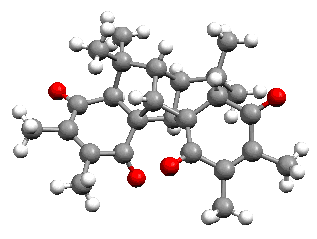
Common molecules sample 50985 - Reciprocal Net Log in
You will need to download and install a Java plug-in in order to view this applet. Download Sun's Java plug-in from here.

Switch to another visualization applet:

> miniJaMM open in new window...
- JaMM1
- JaMM2
Empirical formula: C26H30O4
a: 17.849 Å
b: 18.820 Å
c: 12.721 Å
α (alpha): 90.00 °
β (beta): 90.00 °
γ (gamma): 90.00 °
Volume: 4273.22 Å3
Space group: Pccn
Calculated density: 1.264 g/cm3
Z: 8
Temperature: 22.0 °C
Formula weight: 406.522 g/mole
R(F): 0.0760
Structural formula: C26H30O4
Common name: Plastoquinone
CSD refcode: HMFLUT10
Keyword: photosynthesis
Keyword: photosystem II
Keyword: plastoquinol
Short description: Plastoquinone is an essential component in the process of photosynthesis, specifically in photosystem II.
IUPAC name: 5,6,6a,7,7a,11b-Hexahydro-2,3,5,5,7,7,9,10-octamethyl-6,11a,11cmetheno- 1H-benzo(c)fluorene-1,4,8,11(4aH)-tetrone
Citation of a publication: W.H.Watson, J.E.Whinnery (1973) Acta Crystallogr.,Sect.B:Struct.Crystallogr.Cryst. Chem.,29,1763
Layman's explanation: In 1959, F.L. Crane named plastoquinone for its concentration in the chloroplasts of higher plants. Plastoquinone is a yellow crystalline solid that is soluble in most organic solvents and is involved in the formation of the photosynthetic electron transport chain. This plant molecule has also been found to be an essential component in carotenoid synthesis. There are three different redox states of a plastoquinone: the fully oxidized, called Q; the half reduced/oxidized semiquinone form QH-; and the fully reduced form, plastoquinol, QH2.
Lab name: Common molecules
Sample provider: Obtained courtesy of the Cambridge Structural Database
Status: Complete, visible to public
Repository Files:
50985.cif 50985.crt 50985.gif 50985.ort 50985.pdb
50985.sdt

Reciprocal Net site software 0.9.1-50, copyright (c) 2002-2009, The Trustees of Indiana University
Files and data presented via this software are property of their respective owners.
Reciprocal Net is funded by the U.S. National Science Foundation as part of the National Science Digital Library project. NSDL