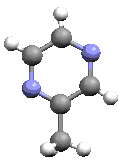
2-methylpyrazine has been used as a food additive due to its nutty aroma. It has also been declared to smell like potato, cocoa, and to give a musty scent. The measured odor
detection threshold of this compound in water is 60,000ppb. 2-methylpyrazine is used as an AWA
odorant in experiments with worms because it causes a more rapid adaptation of
the neurons than any other odorants. These studies focus on the olfactory
plasticity in C. elegans. AWA is an amphid sensory neuron which detects certain odors. 2-methyl pyrazine is also one of the 599 additives in cigarettes as well as an odorant in popcorn.
Citation of a publication:
V.R.Thalladi, A.Gehrke, R.Boese;
New J.Chem.(Nouv.J.Chim.), 24, (2000), 463
Lab name:
Common molecules
Sample provider:
Obtained courtesy of the Cambridge Structural Database
Reciprocal Net site software 0.9.1-50,
copyright (c) 2002-2009, The Trustees of Indiana University
Files and data presented via this software are property of their
respective owners.
Reciprocal Net is funded by the U.S. National Science Foundation as part of
the National Science Digital Library project.