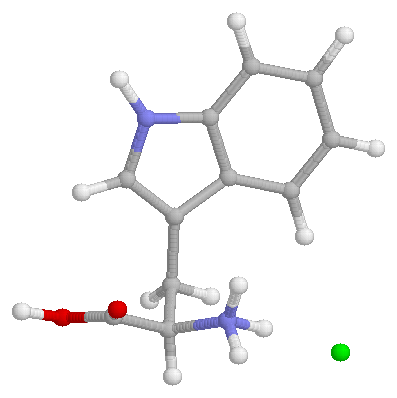
Tryptophan is an essential, hydrophobic amino acid.
Keyword:
serotonin
Keyword:
niacin
Keyword:
sleep
CAS registry number:
73-22-3
IUPAC name:
2-Amino-3-(1H-indol-3-yl)-propionic acid
Citation of a publication:
T. Takigawa, T. Ashida, Y. Sasada,
M. Kakudo; Bull.Chem.Soc.Jpn., 39, (1966), 2369
Miscellaneous comments:
The crystallographic data listed are those of L-Tryptophan hydrochloride. To date, a crystal structure of unprotonated tryptophan has not been reported.
Layman's explanation:
Tryptophan is highly important as it is the metabolic precursor to serotonin. Serotonin is well-known for the psychological effects resulting from an imbalance of this neuroactive chemical. Food sources of tryptophan are dairy products, beef, poultry, barley, brown rice, fish, soybeans, and peanuts. Intake of tryptophan can increase the desire to sleep, hence the inclination to nap after Thanksgiving turkey eating. Although highly necessary, tryptophan is only obtained in about 1 to1.5 grams in a normal diet. Luckily, smaller amounts of tryptophan are more well-accepted by the body than larger amounts (6-9 g). A deficiency of tryptophan can cause aggressive behavior. Shown in the applet is the cationic part of L-tryptophan hydrochloride, (C11H13N2O2)+.
Lab name:
Common molecules
Sample provider:
Obtained courtesy of the Cambridge Structural Database
Reciprocal Net site software 0.9.1-50,
copyright (c) 2002-2009, The Trustees of Indiana University
Files and data presented via this software are property of their
respective owners.
Reciprocal Net is funded by the U.S. National Science Foundation as part of
the National Science Digital Library project.