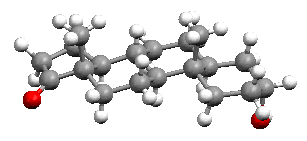
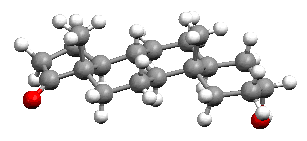
Butenandt received the Nobel Prize in Chemistry in 1939 for studying sex hormones.
Butenandt, in his acceptance speech, described how he was able to isolate a new
compound from male urine that he called androsterone. Ruzicka, the scientist that
shared the prize, was the first to synthesize this chemical in 1935 from a
cholesterol derivative. This androgen plays a role in controlling male sexual development.
This chemical may also serve as a pheromone according to researchers at the
Ludwig-Bolzman-Institut in Vienna, but it was found to be active mostly when a woman
was ovulating.
Reciprocal Net site software 0.9.1-50,
copyright (c) 2002-2009, The Trustees of Indiana University
Files and data presented via this software are property of their
respective owners.
Reciprocal Net is funded by the U.S. National Science Foundation as part of
the National Science Digital Library project.