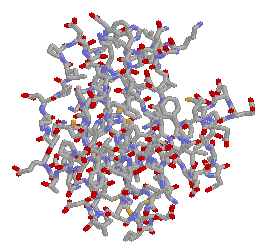
Ferredoxin is a reducing agent used in production of bioelements.
Keyword:
Mortenson
Keyword:
photosynthesis
Keyword:
electron carrier
Keyword:
iron-sulfur protein
Miscellaneous comments:
MEAN B VALUE(OVERALL, A**2) : 21.0
DATA USED IN REFINEMENT.
RESOLUTION RANGE HIGH(ANGS):2.10
RESOLUTION RANGE LOW (ANGS): 8.0
DATA CUTOFF (SIGMA(F)): 0.0
DATA CUTOFF HIGH (ABS(F)): NULL
DATA CUTOFF LOW (ABS(F)): NULL
COMPLETENESS (WORKING+TEST)(%): 92.0
NUMBER OF REFLECTIONS: 8225
Layman's explanation:
In 1962 Mortenson coined the word ferredoxin to a protein isolated from Clostridium pasteurianum an anaerobic, chlorophyll-free bacterium. He found that this protein was free of heme and flavin but contained iron. This protein is an electron carrier; and is involved in photosynthesis, and in nitrogen and sulfur metabolism. Today, ferredoxin describes a group of proteins that are low molecular weight iron-sulfur proteins found also in aerobic organisms.
Copyright notice:
Arnon, D. I.; Trends in Biochemical Sciences; 1988, 13 (1), 30-33
Arnon, D. I., Tsujimoto, H. Y.; Tang, G. M. S.; Febs Letters; 1980, 120 (1), 119-124.
Teshima, K.; Fujita, S.; Hirose, S.; Nishiyama, D.; Kurisu, G.; Kusunoki, M.; Kimata-Ariga, Y.; Hase, T.; FEBS Letters; 2003, 546, 189-194.
Reciprocal Net site software 0.9.1-50,
copyright (c) 2002-2009, The Trustees of Indiana University
Files and data presented via this software are property of their
respective owners.
Reciprocal Net is funded by the U.S. National Science Foundation as part of
the National Science Digital Library project.