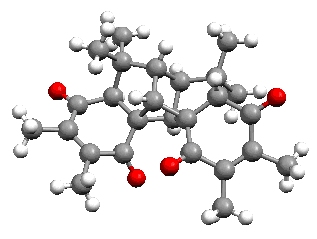
In 1959, F.L. Crane named plastoquinone for its concentration in the chloroplasts of higher plants. Plastoquinone is a yellow crystalline solid that is soluble in most organic solvents and is involved in the formation of the photosynthetic electron transport chain. This plant molecule has also been found to be an essential component in carotenoid synthesis. There are three different redox states of a plastoquinone: the fully oxidized, called Q; the half reduced/oxidized semiquinone form QH-; and the fully reduced form, plastoquinol, QH2.
Reciprocal Net site software 0.9.1-50,
copyright (c) 2002-2009, The Trustees of Indiana University
Files and data presented via this software are property of their
respective owners.
Reciprocal Net is funded by the U.S. National Science Foundation as part of
the National Science Digital Library project.