Reciprocal Net Site sponsor
   Site Info    |    Search
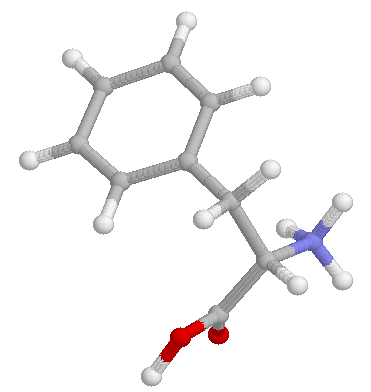
Common molecules sample 50013 - Reciprocal Net Log in
You will need to download and install a Java plug-in in order to view this applet. Download Sun's Java plug-in from here.

Switch to another visualization applet:

> miniJaMM open in new window...
- JaMM1
- JaMM2
Empirical formula: C9H11N1O2
a: 27.763 Å
b: 7.059 Å
c: 5.380 Å
α (alpha): 90.00 °
β (beta): 90.00 °
γ (gamma): 90.00 °
Volume: 1054.37 Å3
Space group: P212121
Calculated density: 1.041 g/cm3
Z: 4
Formula weight: 165.192 g/mole
R(F): 0.0840
Common name: Phenylalanine
CSD refcode: PHALNC01
Keyword: Phenylketonuria
Keyword: essential amino acid
Short description: An essential amino acid which aids in the biosynthesis of several neurotransmitters.
CAS registry number: 63-91-2
Citation of a publication: Reference: Acta Crystallogr.,Sect.B, 31, 2461,1975 Authors: A.R. AI-Karaghouli, T.F. Koetzle
IUPAC name: 2-Amino-3-phenyl-propionic acid
Layman's explanation: Phenylalanine is an essential amino acid, meaning it cannot be manufactured by the human body and must be obtained from outside sources. The body metabolizes phenylalanine and turns it into an amino acid called tyrosine, which, in turn, makes certain hormones for the body. A rare disorder called Phenylketonuria (PKU) occurs when the body is not able to metabolize phenylalanine; this can lead to irreversible mental retardation if not treated. All newborns are tested for the disease within the first 48 hours of life.
Lab name: Common molecules
Sample provider: Obtained courtesy of the Cambridge Structural Database
Status: Complete, visible to public
Repository Files:
50013.cif 50013.crt 50013.GIF 50013.ort 50013.sdt
50013f.crt 50013f.pdb 50013f.sdt

Reciprocal Net site software 0.9.1-50, copyright (c) 2002-2009, The Trustees of Indiana University
Files and data presented via this software are property of their respective owners.
Reciprocal Net is funded by the U.S. National Science Foundation as part of the National Science Digital Library project. NSDL